How To · 6 min read · Oct 14, 2026
Writing Whitepapers That Feel Insightful, Not Overwritten
A practical guide to whitepaper structure, argument and editing. Learn how to add depth, use evidence well and keep B2B thought leadership clear.
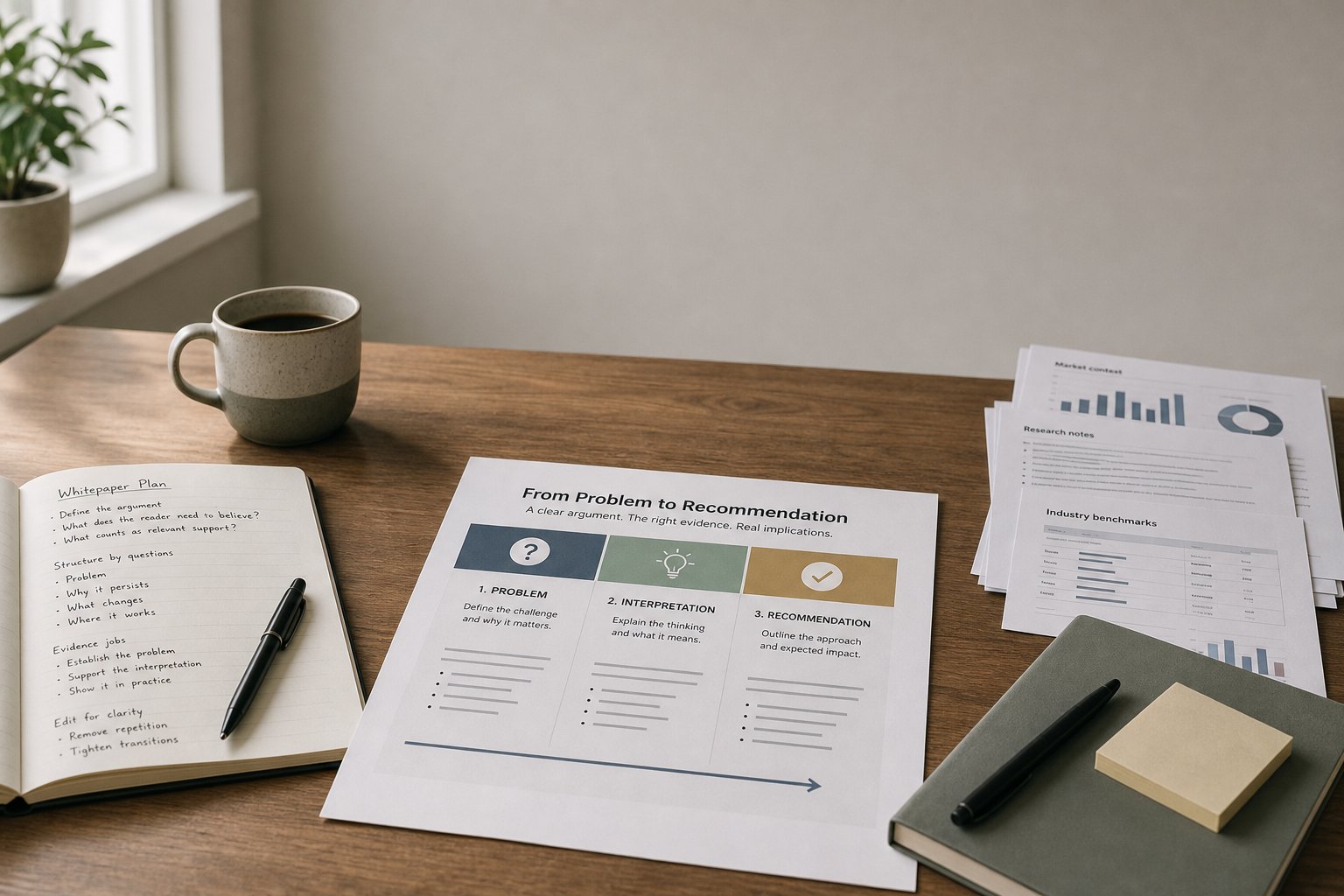
Whitepapers earn attention when they make a clear argument and then support it with the right amount of detail. When they feel overwritten, the problem is rarely that the topic is too complex. More often, the structure is loose, the point of view is delayed, and every section tries to sound equally important.
For B2B teams, the challenge is not to write less. It is to decide what the whitepaper is trying to prove, which evidence is doing real work, and where technical detail belongs in the argument. That is the difference between a document that feels considered and one that reads like it was expanded to hit a page count.
What a whitepaper should do for the reader
A strong whitepaper helps a reader understand a business problem, the thinking behind a position, and the implications of acting on that position. It is not a brochure in disguise, and it is not a dump of background research. Its job is to make a case that feels worth taking seriously.
That means the paper needs a point of view early enough to orient the reader. If the argument is hidden until the final section, the rest of the document can feel like setup without purpose. A clear position does not need to be loud. It does need to be specific enough that the reader can tell what the paper stands for.
A useful test is simple: if someone skimmed the introduction, headings and final section, would they know the argument and why it matters? If not, the paper probably has information, but not direction.
How to define the argument before you draft
Before writing a whitepaper, decide what claim the document is making and what evidence is needed to support it. That claim might be about a market problem, a technical approach, an operating model or a strategic choice. The point is to narrow the paper to one main line of reasoning.
A practical way to do that is to write three decisions before drafting:
- What is the paper arguing?
- What does the reader need to believe for that argument to make sense?
- What would count as relevant support, and what would be interesting but unnecessary?
This prevents the common problem of gathering too much material and then trying to make it coherent later. When the argument is clear, every paragraph has a job. Without that discipline, sections tend to accumulate because they are useful on their own, even if they do not move the case forward.
It also helps to separate evidence from exposition. Some material is there to prove a point. Some is there to explain a mechanism. Some is there only to help the reader follow the logic. If you treat all three as the same kind of content, the paper gets heavier without getting sharper.
How to structure sections around insight, not volume
Section structure should help the reader move through the argument in a controlled order. A good whitepaper usually starts with the problem or context, moves into the interpretation, then explains the implications or recommended approach. That order works because it gives the reader a reason to care before asking them to absorb detail.
The mistake to avoid is building sections around topics rather than questions. A topic-led structure often produces repetition, because each section tries to reintroduce the same background from a slightly different angle. A question-led structure is more selective. It forces each section to answer something the reader actually needs to know next.
For example, a paper about a new operating model might need sections that answer:
- What problem does the current approach create?
- Why does that problem persist?
- What changes when the new model is applied?
- Where does it work, and where does it need adaptation?
That sequence keeps the paper moving. It also makes it easier to trim, because any paragraph that does not answer one of those questions is probably doing decorative work.
How much evidence, example and technical detail is enough
Evidence in a whitepaper should increase confidence, not overwhelm the line of reasoning. The reader does not need every data point or every technical branch of the subject. They need the pieces that make the argument credible and concrete.
Use evidence for three different jobs. First, to establish that the problem is real. Second, to show why the proposed interpretation is reasonable. Third, to demonstrate what the idea looks like in practice. If the paper uses evidence for only one of those jobs, the rest of the copy tends to lean on repetition.
Examples are especially useful when they are bounded. A short scenario can show the mechanism without turning the paper into a case study. For instance, if the point is about workflow design, one concise before-and-after example can show where delay enters the process and how the proposed structure removes it. The example should make the argument easier to grasp, not create a second argument.
Technical detail deserves the same discipline. Include enough to prove the writer understands the subject, but only where the detail changes the reader’s view of the recommendation. If a technical explanation does not alter the decision, it belongs in a note, appendix or external reference, not in the main flow.
How to edit so the paper feels considered, not padded
Editing a whitepaper is mostly an exercise in removing duplicate work. Many overwritten papers do not have bad writing in every paragraph. They have the same point said three different ways because each section was drafted in isolation.
Start by looking for repeated functions. If one paragraph defines the problem, and the next two paragraphs restate it with slightly different phrasing, keep the strongest version and move on. If two sections both explain why the issue matters, combine them unless each one supports a different part of the argument.
Then check transitions. Weak transitions often create the feeling of padding because they restate the previous point before moving to the next one. A better transition usually does one of three things: signals a shift in the logic, narrows the focus, or introduces the next constraint. It should not re-explain the whole section.
A useful editing pass is to ask of each paragraph: what does this add that the previous paragraph did not? If the answer is only emphasis, the paper is probably carrying too much weight in too few ideas.
A quick edit check for whitepaper clarity
Use this as a final scan:
- Is the main argument visible in the opening pages?
- Does each section answer a distinct question?
- Is the evidence doing specific work, not just filling space?
- Are examples bounded and relevant to the claim?
- Can any repeated explanation be cut without weakening the argument?
If the answer to any of those is no, the paper likely needs tightening rather than more material.
Keeping depth without losing the reader
The best whitepapers feel rigorous because they make careful choices. They do not try to cover everything. They choose an argument, build it in a clear order, and use evidence where it matters most.
For B2B teams, that often means better planning before drafting and more ruthless editing afterwards. Hally Writer’s value in that process is not more copy for its own sake, but the brand knowledge, structure and editorial judgement that make the document scalable and genuinely useful. Better business content starts with better context.
Was this article helpful?