How To · 6 min read · Oct 20, 2026
How to Write Service Pages That Explain Value Clearly
Write service pages that explain what you do, who it is for and why it matters. A practical guide to clearer B2B copy, stronger fit and better enquiries.
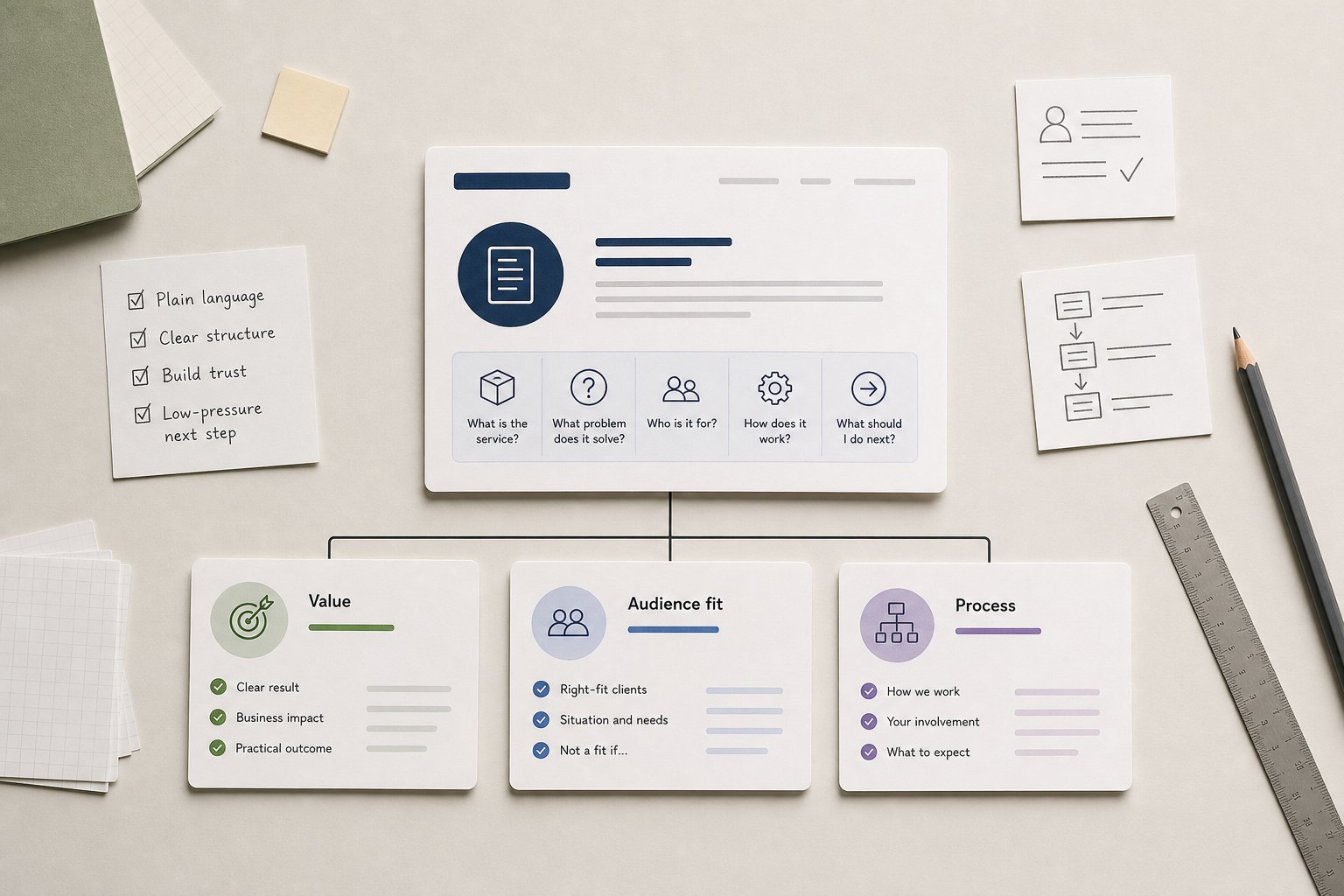
A service page often fails for a basic reason. It names the offer, then leaves the reader to infer what problem it solves, who it suits and whether it is worth an enquiry. That creates friction before the page has earned any trust.
For B2B businesses, clarity is not a cosmetic choice. It shapes enquiry quality. When the page explains the service in plain language, identifies the right-fit client and shows how the work runs in practice, readers can decide whether to continue without guessing.
What a strong service page needs to answer
A strong service page answers five questions quickly.
- What is the service?
- What problem does it solve?
- Who is it for?
- How does it work?
- What should I do next?
If those answers are hidden in broad claims and vague benefit lines, the page may feel active without helping the reader make a decision. The problem is not usually a lack of information. It is a lack of order.
A useful test is to read the page as someone who has never met the business before. If the offer still feels open to interpretation after the first pass, the page needs a sharper definition and a clearer sequence.
How to explain the service in plain language
Start with the service as a buyer would name it. Not every page needs a clever opening. It needs a sentence that tells the reader what the business actually does.
A workable pattern is to state the service, the type of business it supports and the result it is designed to create. For example, instead of writing about “strategic communication solutions”, the page might say the business helps B2B teams plan and write content that is easier to use, approve and publish.
That shift matters because internal language often describes the method rather than the value. A buyer usually cares less about the mechanism on its own and more about the practical result. If the wording stays close to the company’s internal vocabulary, the page asks the reader to translate.
Keep the phrasing specific enough to be useful, but not so narrow that it reads like a technical spec. The aim is to remove doubt, not to make the offer sound bigger than it is.
A useful editing test
Ask whether someone outside the company could repeat the service back accurately after one reading. If they could not, the wording still carries too much internal shorthand.
How to show who the service is for
A service page becomes more persuasive when it names the right-fit client clearly. That is not about shutting people out. It is about helping the right people recognise themselves.
Describe the situation the service is built for. A B2B content service might suit teams that need more output, stronger editorial consistency or a better way to turn subject knowledge into clear, on-brand content. That is more useful than broad audience labels on their own.
It can also help to say who the service is not for when that would prevent a mismatch. If the working style is consultative, say so. If the process depends on collaboration, say that too. A reader who wants quick commodity output should understand that the offer works differently.
The goal is fit, not reach. A page that attracts fewer but better-matched enquiries is doing a better job than one that sounds relevant to everyone and clear to no one.
How to use proof and process to build trust
Readers often do not need a long argument for why the service exists. They need evidence that the business knows how the work gets done.
That proof does not have to be awards, customer counts or statistics. It can be the shape of the process itself. Explain how the work begins, what information is needed, how decisions are made and what the client can expect at each stage. For content services, that might include brand context, editorial judgement, drafting, review and refinement.
This kind of detail does two things. It shows the service is considered, not improvised. It also helps the reader imagine the working relationship in practice, which is often more persuasive than broad claims about quality.
Use this section to answer the questions buyers are likely to have before they enquire:
- How much input is needed from us?
- What happens after we get in touch?
- How do you handle brand knowledge and tone?
- What does collaboration look like?
The more concrete the process, the less the page has to lean on reassurance.
How to finish with a next step that feels low-pressure
A service page should invite action without sounding pushy. For B2B readers, a lower-pressure next step often works better than a hard close.
A direct enquiry button is fine, but the surrounding copy matters. A line that points to a conversation, review or discovery call feels more appropriate than one that implies instant transformation. If the reader is still comparing options, the page should make it comfortable to ask a question before committing.
Good closing copy usually does three things. It restates the kind of help on hand, lowers the cost of getting in touch and leaves room for an initial conversation. That can be as direct as inviting the reader to talk through the brief and see whether the service is a fit.
Avoid closing with urgency that has no real substance. The strongest finish feels useful, steady and open.
Examples: a clearer service page in practice
Here is the kind of structure that keeps the page moving in the right order.
| Section | Job |
|---|---|
| Opening | State the service and the main value clearly |
| Problem framing | Show the business issue it solves |
| Fit | Explain who it is for and who it suits best |
| Process | Show how the service works in practice |
| Proof | Add examples, deliverables or other concrete evidence |
| Call to action | Invite a low-pressure next step |
A page built this way helps the reader move from definition to relevance to trust. It also matches how many buyers read service pages. They want the offer first, then the fit, then enough detail to decide whether to enquire.
A clear service page helps the reader decide
The best service pages do not try to impress through volume. They help the reader understand the offer, judge fit and choose a next step without extra interpretation.
For B2B businesses, that usually means plain language, visible process, a clear sense of audience and a calm call to action. Hally Writer’s own position follows the same principle. Better business content starts with better context, and a service page works best when that context is easy to see.
Was this article helpful?