Content Strategy · 7 min read · Aug 11, 2026
Turn a content strategy into a practical content plan
Learn how to turn strategy into a practical content plan with priorities, ownership, journey mapping, scheduling and measurement.
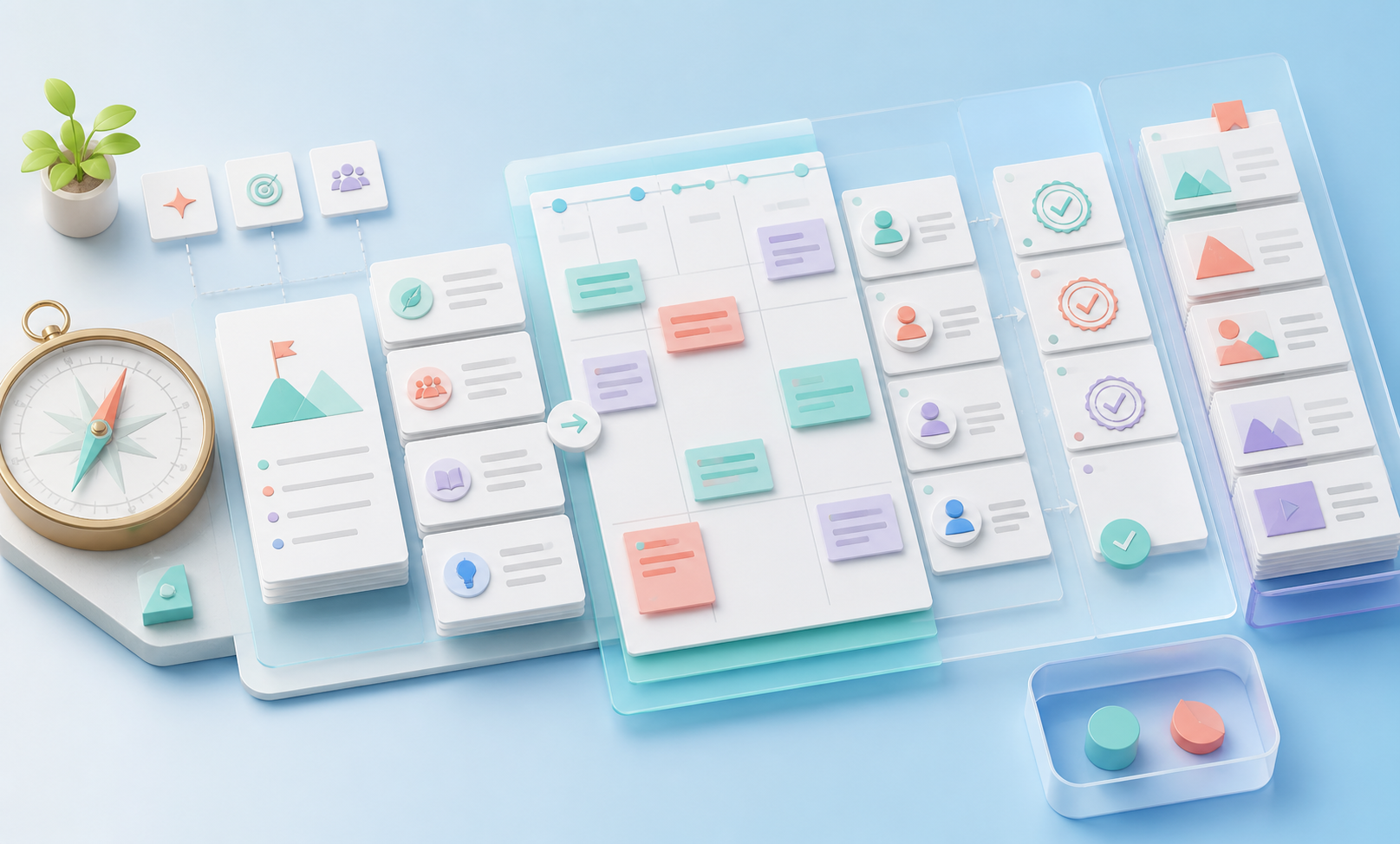
Turn a content strategy into a practical content plan
A strategy only becomes useful when it starts driving decisions. A Content plan is the bridge: it turns direction into choices about what gets made, who handles it and when it moves. Without that bridge, teams may have clear intent but weak execution, with drafts waiting on review, topics competing for space and publishing becoming reactive.
Start with the decisions the plan has to settle
A strategy sets direction. A plan turns that direction into operating choices.
Before anyone opens a calendar or spreadsheet, define the decisions the plan needs to answer. At minimum, the team should know:
- what business objective each piece supports
- who the audience is
- which stage of the customer journey it serves
- what format is needed
- who owns the brief, draft, review and approval
- how success will be judged
That list matters because gaps tend to get filled with guesswork. If no one has named the audience, the topic can drift. If no one has named the approver, work stalls. If the journey stage is unclear, the piece is asked to do too much.
For B2B teams, the useful test is straightforward: can someone pick up the plan and see what happens next without asking for extra context? If not, the plan is still behaving like a strategy document.
Define priorities before you set output targets
A common planning failure is to begin with volume. A more workable approach is to decide what matters first, then work out how much the team can produce well.
Priority setting does not need a complicated scoring model. A practical filter is enough:
- Name the business need the content supports.
- Check whether the topic matters to the audience and to the business.
- Confirm the team has enough brand knowledge and subject knowledge to make it genuinely useful.
- Decide whether the piece is core, supporting or optional.
- Check whether it can be delivered with the capacity available.
This avoids building a queue that looks active but does little useful work.
A clear priority split helps keep the plan honest:
- Core content: essential pieces linked to important journeys, service pages or product needs
- Supporting content: material that deepens the core themes or answers likely questions
- Opportunity content: timely or experimental ideas that only happen if there is room
That structure is especially useful when requests come in from across the business. It creates a shared way to decide whether a topic belongs in the next planning cycle, instead of treating every request as equally urgent.
Assign ownership so work can move cleanly
A plan breaks down quickly when ownership is vague. “The content team” is not an owner. A workable plan names people for specific stages and makes the handovers visible.
At minimum, assign responsibility for:
- the brief
- the draft
- subject-matter input
- editorial review
- final approval
- publishing
- post-publication updates
This is not administration for its own sake. It is the structure that stops work sitting in inboxes. When ownership is clear, people know what they are expected to do, what they are waiting for and when they need to step in.
Ownership should also reflect the type of content. A thought leadership piece may need tighter editorial judgement and a more careful review path than a product explainer. A high-stakes page may need legal or leadership input. A shorter resource may move faster if the brand context is already well documented.
That is where context matters. Teams that want scalable, on-brand output need more than a list of names. They need a workflow that carries brand knowledge and structure through the process, so quality does not drop as volume rises.
Map content to the customer journey, not just the calendar
A publishing schedule only tells you when something goes live. A content plan should also show why the asset exists and what role it plays in the customer journey.
That distinction is practical. Journey mapping helps teams spot gaps, avoid duplication and set realistic expectations for each piece.
A reader at an early stage usually needs help understanding the problem, category or opportunity. A reader in the middle of the journey needs help comparing approaches or evaluating options. A reader closer to purchase needs help choosing a supplier, service or next step. If those stages are blurred, the same article ends up carrying too much weight.
A simple structure is often enough:
Awareness
Help the reader understand the problem or opportunity.
Consideration
Help the reader compare approaches, methods or solutions.
Decision
Help the reader choose with enough confidence to act.
Not every plan needs equal depth at every stage. The point is to make sure the content library reflects the customer journey the team is actually supporting, rather than a list of topics the business already likes.
Build the schedule around capacity, not hope
Even strong ideas fail when the schedule assumes unlimited time. A useful plan starts with available capacity and works backwards from that.
The team should be clear on:
- how many pieces can be briefed, written, reviewed and published in a period
- which work depends on other people’s input
- which deadlines are fixed and which can move
- which formats need more editorial effort
- where buffer time is needed for rewrites, approvals or delays
This is especially important where there are several stakeholders. A schedule that ignores review time usually becomes a bottleneck later.
It also helps to plan for maintenance. Some content needs updating as well as new production. If refresh work is never scheduled, older assets can drift out of date and stop supporting the wider content library.
A mixed schedule is often the most workable option. Some slots are reserved for planned campaigns or commercial priorities. Others stay open for updates, responsive topics or urgent business needs. That gives the plan enough structure to stay useful without making it brittle.
Measure delivery, quality and performance separately
Measurement should reflect what the plan is meant to change. If the goal is better consistency, traffic alone is not a useful scorecard. If the goal is pipeline support, visibility on its own is not enough.
A practical way to review a content plan is to track three layers:
- delivery: were the planned pieces briefed, produced and published on time?
- quality: did the work follow the brief, brand context and editorial standards?
- performance: did it support the audience behaviour or business outcome the piece was meant to influence?
The right metrics depend on the asset. A strategy article may be reviewed for engagement and assisted conversions. A core service page may be judged on search visibility and lead quality. An internal enablement asset may be measured by adoption and usefulness.
The important part is consistency. A plan becomes easier to improve when the team measures the same things in the same way, month after month. Without that, it is hard to tell whether changes in output reflect better planning or a different way of counting success.
A downloadable planning framework
Use the framework below as a working template in a spreadsheet, shared document or planning board.
| Planning field | What to capture |
|---|---|
| Business objective | What the content should support |
| Audience | Who the content is for |
| Journey stage | Awareness, consideration or decision |
| Priority level | Core, supporting or opportunity |
| Content format | Article, landing page, guide, email, case study or other |
| Working title | Clear internal title for the asset |
| Owner | Person responsible for progress |
| Reviewer | Person checking accuracy, tone or sign-off |
| Deadline | Target publication date |
| Channel | Where it will be published or distributed |
| Success measure | How the piece will be evaluated |
| Notes | Dependencies, source material or approval needs |
This framework keeps the plan concrete. It gives the team one place to see context, workflow and success measures before work starts.
What a workable plan looks like in practice
If a team is preparing a service launch, the plan might prioritise a decision-stage landing page, a small set of consideration-stage articles and a supporting email sequence. Ownership would be split across briefing, drafting, review and publishing, with delivery and quality checked before performance is reviewed.
If the goal is to improve an existing content library, the plan might give more weight to refresh work than to new topics. In that case, the schedule should include updates alongside new production, and the success measure should include content health as well as output.
Those shifts are small, but they change how the work feels. The strategy stops being a document that sits above the work and becomes a system the team can actually use.
Move from direction to execution
A good content plan gives the team priorities, ownership, a workable schedule and a clear way to judge whether the content is doing its job. It does not try to solve every problem at once. It makes the next round of work easier to brief, easier to deliver and easier to review.
If your team wants a more structured way to turn brand knowledge and editorial judgement into scalable content, create content plans in Hally Writer.
Meta guidance
Was this article helpful?