Content Strategy · 6 min read · Oct 5, 2026
Product Listing Copy That Helps Buyers Decide Faster
Product listings should do more than describe. See how to write clearer, more useful copy that answers buyer questions, explains features and makes comparison easier.
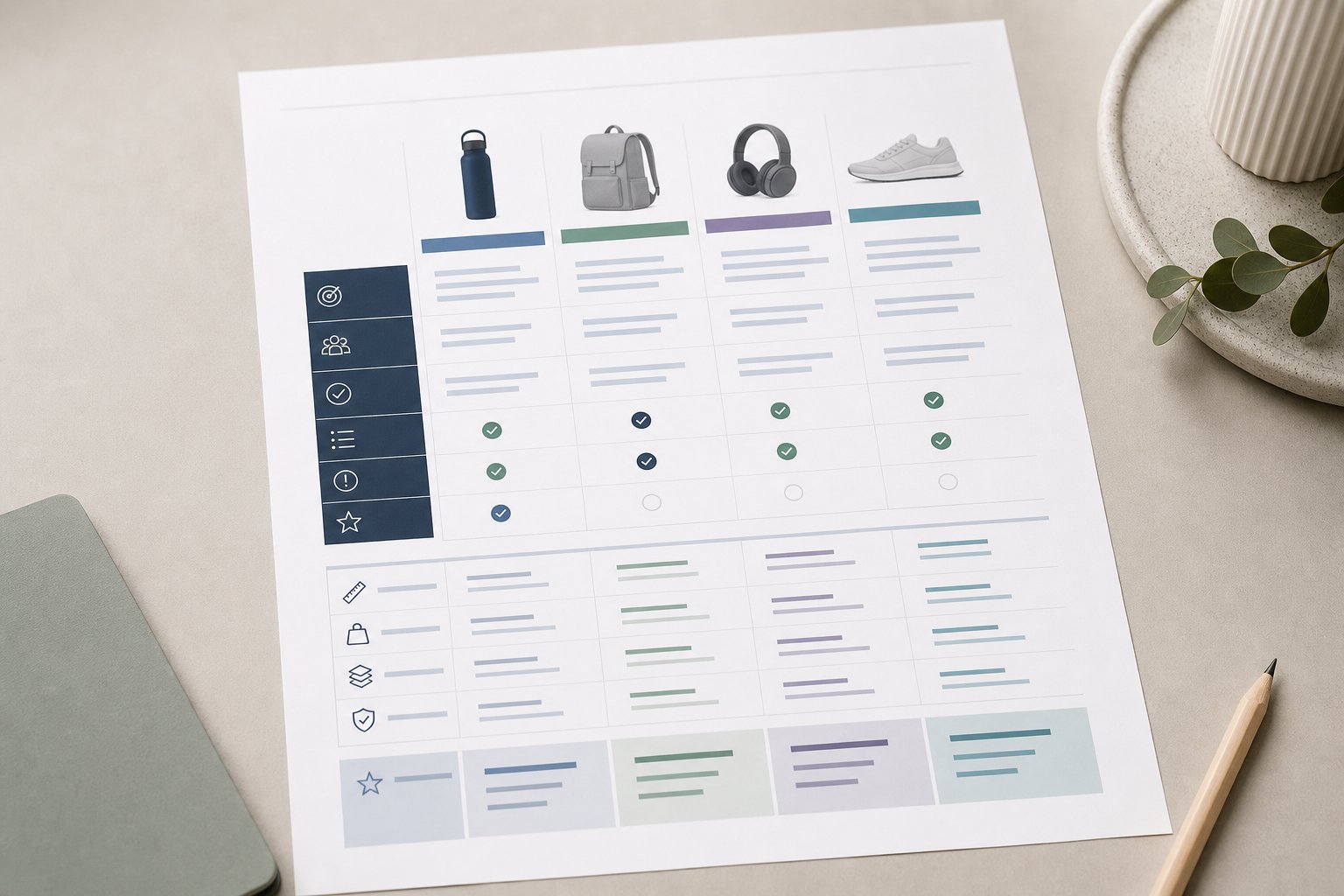
Product listings do more than describe an item. They carry the decision-making load: what it is, who it is for, what problem it solves, and why it is worth choosing over something similar. When that information is buried under vague benefit claims or technical clutter, buyers have to do the work themselves.
Good product copy reduces that effort. It gives people enough context to compare options, rule things out quickly, and move forward with more confidence.
What product listings need to answer
A useful listing answers the questions a buyer is already carrying. Not every shopper needs the same detail, but most are looking for a few core things:
- What does this do?
- Who is it for?
- What makes it different?
- What should I know before I buy?
- Is this the right choice for my use case?
If the copy does not address those points clearly, buyers often leave with partial understanding. That can create hesitation even when the product itself is a good fit.
For ecommerce, this usually means helping someone imagine ownership and use. For B2B catalogues, it often means making suitability easier to judge against a spec sheet, procurement need or internal approval process.
The job is not to say everything. It is to answer the questions that stop a buyer from deciding.
Lead with the benefit that matters most
A strong listing opens with the most relevant outcome, not the broadest claim. The best starting point is the benefit that matters most to the buyer in that context.
For example:
- If a product saves time, say what task becomes faster.
- If it improves accuracy, say where the error risk goes down.
- If it is easier to set up, say who can use it without specialist help.
- If it is more durable, say what kind of use it is built to handle.
This is where buyer-led copy earns its value. Features matter, but only once they are connected to a practical reason to care. A stainless steel casing is only useful in copy if it tells the reader something specific about wear, hygiene, or performance in a particular environment.
The key is relevance. A headline benefit should reflect the decision the buyer is trying to make, not the phrase that sounds most polished on the page.
Write features as specific reasons to buy
Feature descriptions become more useful when they explain impact. That does not mean turning every feature into a sales claim. It means showing what the feature does in practice.
Instead of:
- “High-performance design”
- “Advanced functionality”
- “Premium materials”
Use wording that names the detail and its consequence:
- “Built with reinforced seams for repeated daily use”
- “Includes adjustable shelving for mixed-size stock”
- “Supports multiple file formats for easier team handover”
Specificity gives the buyer something to evaluate. It also protects the copy from sounding interchangeable with every other listing in the category.
A practical way to test a feature line is to ask: if this were removed, would the buyer still know why it matters? If the answer is no, the line needs more context.
This is especially important for teams writing at scale. Once listings start to share the same adjectives, they lose usefulness fast. Structure and editorial judgement matter more than longer copy.
Handle technical details without clutter
Technical information is often essential, but it should not dominate the page. Buyers need enough detail to check fit, not so much that the main point gets lost.
The simplest approach is to separate decision-making copy from reference copy:
- Use the main description to explain purpose and value.
- Use bullet points or a spec block for measurements, compatibility, materials, standards or capacity.
- Keep terminology consistent across listings so comparison is easier.
That structure helps people scan. It also stops technical detail from crowding out the answer to the real question: does this suit my need?
When a product has complex specifications, resist the urge to translate every detail into marketing language. Some buyers want the facts in plain form. If you obscure them, you create extra work instead of removing it.
A useful rule is to write for the first reading and the second reading at the same time. The first pass should tell the buyer whether the product is worth more attention. The second should let them confirm the detail.
Make comparison easy to do
Buyers rarely look at one product in isolation. They compare options, often quickly, and often across tabs or pages. Product copy should support that behaviour.
That means using a consistent structure:
- Lead with the same kind of information in the same place
- Keep labels and feature names consistent
- Avoid changing the order of details from one listing to the next without reason
- Use plain terms where possible so differences are visible
When listings follow the same structure, buyers can compare more easily. They do not need to decode each page before deciding whether to keep reading.
This matters in catalogues, collections and range pages where one product may be close to another. If every item is described differently, the buyer ends up comparing wording rather than product fit.
Consistency also supports internal clarity. Teams editing at scale can spot gaps faster when the copy follows a shared pattern.
Edit for scannability and trust
Clear product copy is usually the result of editing, not adding more text. Once the important information is in place, the next step is to remove anything that slows the reader down.
Look for:
- Repeated claims with no added detail
- Empty phrases such as “best-in-class” or “top-quality”
- Overloaded sentences with too many modifiers
- Jargon that only an internal team would understand
- Benefit statements that are too broad to verify in the page context
Trust comes from restraint. Buyers do not need every line to sound impressive. They need the listing to sound accurate, grounded and useful.
Scannability helps here too. Short paragraphs, clear headings and well-chosen bullets make it easier for a buyer to find what they need without losing the thread. That is especially important when the page must serve both quick browsers and careful evaluators.
For B2B teams, this is where brand knowledge and editorial judgement make a real difference. The copy has to stay on-brand, but it also has to reflect how the product is actually used and judged.
A simple product listing example
Here is a simple comparison of weak and stronger copy.
Weak:
- “Durable, premium water bottle with innovative design for everyday use.”
Stronger:
- “Insulated stainless steel bottle that keeps drinks hot or cold for longer, with a leak-resistant lid for commuting, desk use and travel.”
The stronger version does three useful things:
- It names the product type and core function.
- It links the feature to a practical outcome.
- It gives the buyer a clear sense of when the product fits.
The copy does not need to be dramatic. It needs to be specific enough for the buyer to decide.
Clear product copy makes decisions easier
Product listings work best when they reduce doubt. That happens when the copy answers buyer questions early, turns features into usable reasons to buy, and keeps technical detail in a form that is easy to compare.
For ecommerce teams, product marketers and copywriters, the standard is not more description. It is better decision support.
If your listings are doing too much talking and not enough helping, start by tightening the structure around the buyer’s questions. That is often the quickest route to copy that feels clearer, more credible and more useful.
Was this article helpful?