Content Strategy · 7 min read · Sep 15, 2026
Why the Same Message Can Feel Persuasive, Pushy, or Reassuring
Learn how psychology in content changes how readers feel, what they trust, and which choice they make, with practical phrasing examples.
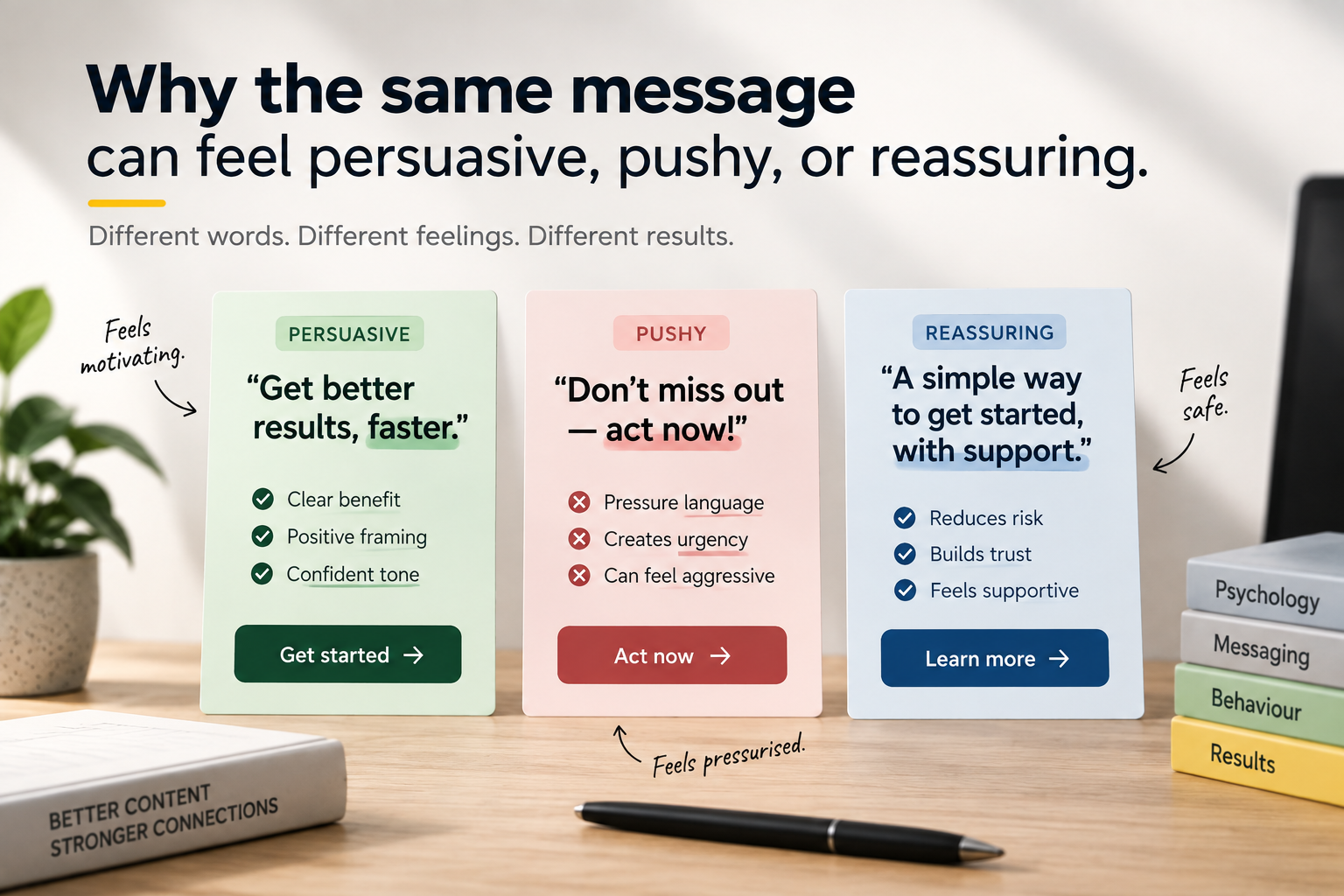
Psychology is already shaping the way people read your content. The question is not whether it is there, but whether it is working for you or against you.
A small change in wording can alter how a reader feels about risk, effort, trust, or urgency. That matters because people rarely make choices on logic alone. They respond to cues: certainty, friction, authority, familiarity, and tone. Good content uses those cues deliberately. Poor content uses them by accident.
For B2B teams, that is not a soft branding issue. It affects whether a page feels clear or vague, helpful or salesy, confident or overbearing. The same offer can look stronger, weaker, safer, or more credible depending on how it is framed.
Psychology in content is about reducing friction, not tricking people
When content works well psychologically, it does not manipulate the reader. It makes the next step feel easier to understand.
That usually comes down to four things:
- Perceived effort: how much work the reader thinks the action will take
- Perceived risk: how safe the choice feels
- Perceived value: whether the outcome seems worth it
- Perceived fit: whether the message feels relevant to the reader’s situation
If your copy increases confusion, it increases friction. If it makes the reader feel informed and in control, it lowers friction.
That is why psychology matters in content strategy as much as it does in headline writing. Structure, order, and phrasing all shape the decision the reader thinks they are making.
The same offer can create different feelings
A useful way to think about psychological framing is to compare how small wording changes change the interpretation.
Example 1: certainty versus pressure
- “Book a call today”
- “If it would help to talk through your options, book a call”
The first version creates urgency. That can work when the reader is already close to deciding. It can also feel pushy if they are still evaluating.
The second version lowers pressure. It gives the reader room to choose without feeling cornered. That is often better for higher-consideration B2B content, where trust matters more than speed.
Example 2: problem-led versus outcome-led framing
- “Stop wasting time on content that does not convert”
- “Create content that supports better decisions”
The first version uses loss aversion. It triggers discomfort with the current situation. That can be effective, but it can also feel accusatory.
The second version feels more constructive. It keeps the focus on improvement rather than failure. The reader may feel more open, especially if they already know the problem and want a practical path forward.
Example 3: vague promise versus concrete mechanism
- “We help teams scale content”
- “We help teams scale content without losing brand knowledge, structure, and editorial judgement”
The first version sounds broad. The reader has to fill in the gaps.
The second version tells them what is protected while scaling. That changes the emotional response from “interesting, but what does that actually mean?” to “this sounds closer to my problem.”
That is one of the most important psychological functions of content: specific language reduces uncertainty.
Choice is shaped by how you frame risk
Readers do not only ask, “Do I want this?” They also ask, “What happens if I choose wrong?”
That is why wording around guarantees, commitments, and next steps matters so much.
Compare these two approaches:
- “Start now and transform your content”
- “If you are looking for a clearer content structure, start with a conversation”
The first frames the decision as a big leap. It may create ambition, but it also raises the stakes.
The second frames the next step as low risk. It does not promise an outcome it cannot prove. It simply offers a practical way to explore fit. That is often better for B2B readers who want confidence, not hype.
Psychologically, this matters because people are more likely to move when the cost of being wrong feels manageable. Content can help by making the next step feel reversible, specific, and sensible.
Structure changes how a reader processes the message
Psychology is not only about individual words. It is also about sequence.
A reader tends to follow the order you give them. If you lead with abstract claims, you ask for trust too early. If you lead with the problem, then the mechanism, then the outcome, you make the argument easier to absorb.
A practical structure often looks like this:
- Name the problem in the reader’s language
- Show why it happens
- Explain what changes when the approach improves
- Make the next step feel safe
That sequence works because it matches how people make decisions. They want recognition first, then explanation, then reassurance.
For example:
- Weak structure: “Our editorial systems improve performance through better context.”
- Stronger structure: “If your team is producing more content but losing consistency, the issue is usually not volume. It is context. Without brand knowledge and clear structure, even good writing drifts.”
The second version starts with the reader’s experience. That creates immediate relevance. Only then does it move into the explanation.
Tone can invite action or trigger resistance
Tone is often the difference between “useful” and “too much”.
A reader may agree with the message and still reject the delivery.
Consider these two lines:
- “You need a better content system.”
- “Your team may need a better content system.”
The first is direct. It can work if the audience already knows there is a problem and wants blunt advice.
The second is softer. It leaves room for judgment. That can be more effective when the reader is not yet convinced, because it avoids sounding like a verdict.
Neither is automatically better. The right choice depends on context:
- Use firmer language when the reader already feels the pain
- Use more open language when the reader is still diagnosing the issue
- Use more specific language when the goal is credibility
- Use more reassuring language when the goal is reducing hesitation
This is where editorial judgement matters. Psychology is not a set of tricks to apply everywhere. It is a way to match the message to the reader’s state of mind.
Realistic examples of phrasing changes and likely interpretation
Here are a few more bounded examples of how wording can shift meaning.
“Affordable” versus “predictable”
- “Affordable content support”
- “Predictable monthly content support”
“Affordable” signals price. It can be interpreted as low cost, but also as low value.
“Predictable” shifts the emphasis to planning and reliability. For teams managing multiple stakeholders, that can feel more useful than a simple cost claim.
“Fast” versus “structured”
- “Fast content delivery”
- “Structured content delivery”
“Fast” appeals to urgency, but can raise concerns about quality.
“Structured” suggests a controlled process. It may feel less exciting, but it often builds more trust in a business setting.
“Expert-written” versus “built with brand context”
- “Expert-written content”
- “Content built with brand context”
“Expert-written” speaks to writer skill.
“Built with brand context” speaks to fit. For teams that have seen content drift away from their positioning, that can feel more relevant because it addresses a common operational problem: strong writing that still misses the mark.
Why psychology matters most when the content is meant to guide a decision
Psychology matters in every format, but it becomes most important when the content is not just informing the reader. It is helping them choose.
That includes:
- service pages
- landing pages
- emails
- calls to action
- comparison content
- proposal or nurture copy
In those settings, the reader is not looking for decoration. They are looking for a reason to move. The wording has to do more than sound polished. It has to make the choice feel understandable, relevant, and safe.
That is also why content should be built with context, structure, and editorial judgement, not just volume. The most persuasive copy is not the loudest. It is the one that aligns the message with how the reader thinks, worries, and decides.
When that balance is right, the content feels clear rather than pushy, useful rather than generic, and credible rather than overworked.
Was this article helpful?