Copywriting · 7 min read · Sep 14, 2026
Writing styles for content writers: choosing the right approach for the job
Explore the main writing styles content writers use, how they differ, and where each works best across blogs, landing pages, guides and more.
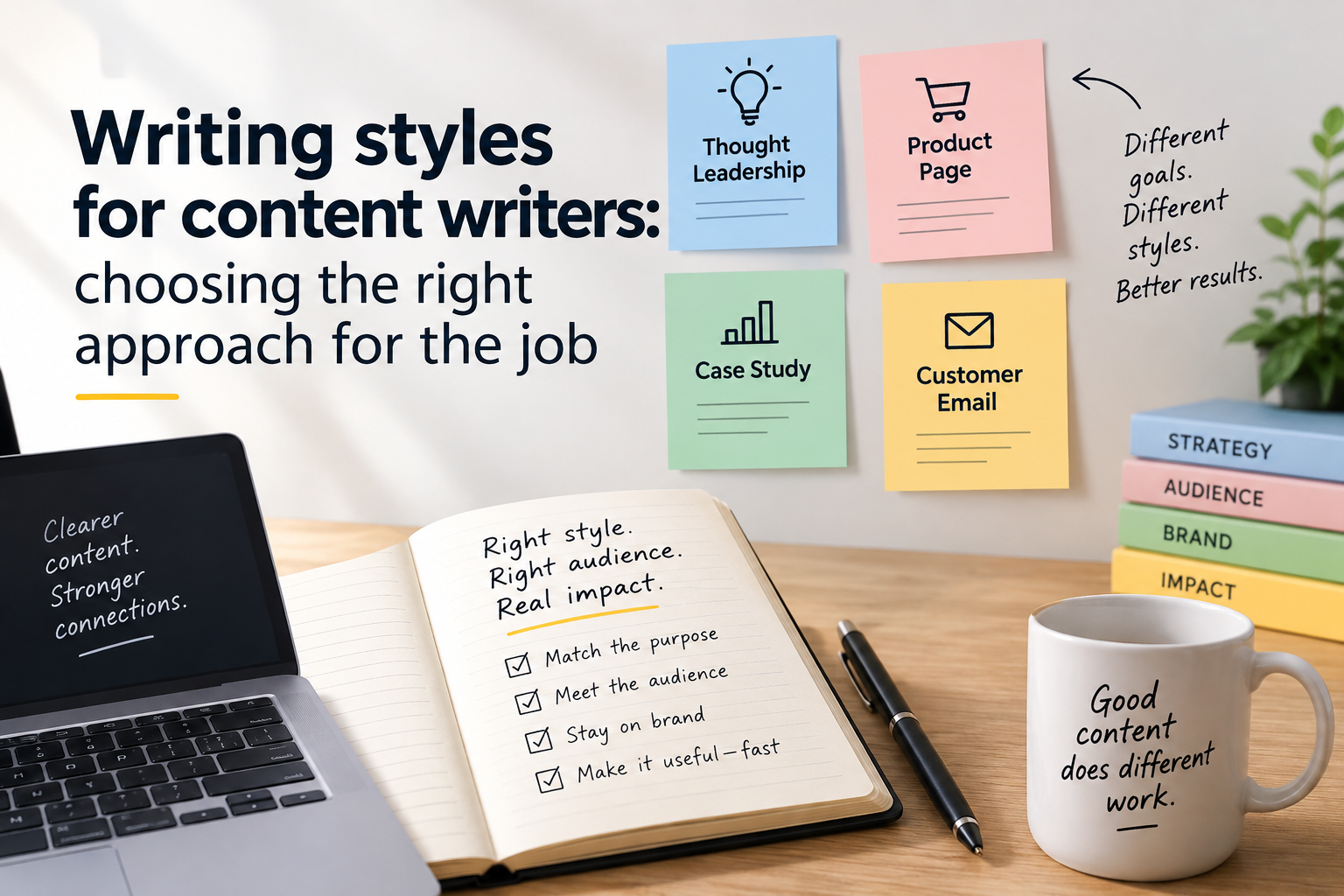
Different writing styles do different work. A style that is ideal for a thought leadership article may be wrong for a product page, a case study, or a customer email. For content writers, the real skill is not just writing well; it is choosing the right style, with the right structure, for the right audience and purpose.
That choice matters because style affects clarity, tone, pace, and how much context the reader needs. In business content, the best writing is usually the style that makes the message useful quickly, stays on brand, and gives the reader the least possible friction.
Why writing style matters in content writing
Writing style is not decoration. It shapes how a reader understands the message and whether they trust it enough to act on it.
For content writers, style decisions sit alongside audience, channel, and objective. A short landing page needs different handling from a long-form guide. A compliance-heavy topic needs more precision than a brand story. A sales enablement asset needs clarity and internal consistency more than literary flair.
In practice, the best style is the one that supports the content job:
- explain something clearly
- persuade without overstatement
- build trust through structure and detail
- move the reader to the next step
If the style fights the job, the content becomes harder to use.
The main writing styles content writers use
Most business content sits somewhere between a few core styles. The names overlap in practice, but the distinctions are useful when deciding how to frame an asset.
Informative writing
Informative writing is designed to explain. It prioritises clarity, definition, and straightforward structure.
It works best when the reader needs to understand a topic before they can decide what to do next. That makes it a strong fit for:
- blog articles
- guides
- help content
- explainer pages
- educational emails
The strength of informative writing is that it reduces uncertainty. The risk is that it can become flat if it only defines terms and never helps the reader apply them. Good informative writing gives enough context to be useful, not just accurate.
Persuasive writing
Persuasive writing is designed to influence a decision. It uses selective emphasis, benefits, proof points, and a clear point of view.
It is best applied where the reader is already considering an action and needs confidence to move forward. Common uses include:
- landing pages
- sales pages
- product pages
- campaign copy
- calls to action
The key difference from informative writing is intent. Informative content helps the reader understand. Persuasive content helps them choose.
For business writers, persuasion should stay grounded in evidence and practical relevance. Overclaiming weakens trust, especially with B2B audiences who expect substance.
Narrative writing
Narrative writing uses story structure to make information easier to follow and remember. It can still be business-focused, but it leans on sequence, tension, and resolution rather than direct explanation alone.
It is often best for:
- case studies
- founder stories
- brand stories
- customer journey content
- internal communications with a human angle
Narrative works well when the point is not just what happened, but why it matters. It helps readers understand change, context, and consequence.
The trade-off is that narrative can drift if it is not controlled. In content marketing, story should support the message, not replace it.
Instructional writing
Instructional writing tells the reader how to do something. It is practical, sequential, and usually action-led.
This style fits:
- how-to articles
- onboarding materials
- process guides
- SOPs
- implementation pages
Its value is in structure. Readers should be able to scan, follow, and apply the content without guessing the next step.
Instructional writing works best when the process is genuinely helpful and the steps are ordered logically. If too much background is added, the clarity drops. If too much is left out, the reader stalls.
Technical writing
Technical writing is designed for precision. It reduces ambiguity and uses exact language, especially where accuracy matters more than tone.
It is commonly used for:
- product documentation
- specs
- process documentation
- regulated or specialist content
- support material
This style is most effective when the audience already has some domain knowledge, or when the content must be unambiguous for operational reasons.
The main difference between technical writing and general business writing is tolerance for detail. Technical writing can be denser because it needs to be precise. But it still needs structure. Precision without structure is still hard to use.
How to choose the right style for a brief
The best style is usually determined by four questions.
What does the reader need to do?
If they need to understand, use informative writing.
If they need to act, use instructional writing.
If they need to decide, use persuasive writing.
If they need to see a process or outcome in context, narrative may be the better fit.
How much context does the reader already have?
A knowledgeable audience can handle more technical density. A less familiar audience usually needs more explanation, shorter sentences, and clearer signposting.
This is where brand knowledge and editorial judgement matter. Good content writers do not just write to topic; they write to the reader’s likely starting point.
How much proof is needed?
Some styles can lean on explanation. Others need evidence, examples, or specific detail.
Persuasive content usually needs the most careful handling because the reader is being asked to trust a recommendation. Informative content still needs accuracy, but it may not need the same level of proof-led argument.
Where will the content live?
The channel changes the style.
A homepage, landing page, and blog article should not sound the same, even if they support the same offer. Structure, pace, and call to action should reflect the place the content is being used.
Where each style is best applied
A simple way to think about application is by content type and reader intent.
- Blog articles: informative or explanatory, sometimes with a light persuasive angle
- Case studies: narrative with evidence
- Landing pages: persuasive with clear structure
- Product pages: informative and persuasive together
- How-to guides: instructional
- Documentation: technical and precise
- Thought leadership: informed, opinion-led, and often narrative in shape
The best content teams do not force every asset into one style. They match the style to the job, then keep the execution consistent with brand knowledge and editorial judgement.
Common style mistakes content writers should avoid
The most common problem is mixing styles without intent.
For example, a guide may start as instructional content but drift into promotional copy halfway through. Or a case study may read like a press release instead of a real example. Or a technical piece may use marketing language where accuracy is needed.
Other common problems include:
- using a persuasive tone when the reader needs clarity
- making informative content too broad to be useful
- adding story where structure would be better
- writing to sound polished rather than to be useful
- losing brand consistency across different writers or channels
These issues are often symptoms of missing context. When writers do not have the right brief, the right structure, or enough editorial judgement, style becomes guesswork.
A practical way to brief content more clearly
If you want stronger writing, brief the style as deliberately as the topic.
A useful brief should answer:
- Who is the reader?
- What should they understand or do?
- What level of detail is appropriate?
- What tone should the piece carry?
- Which parts need to be precise, persuasive, or explanatory?
That kind of context-led briefing makes it easier to create content that is on-brand, scalable, and useful.
For teams producing more content without losing quality, this is often the difference between output and usefulness. Structure, context, and editorial judgement keep the writing aligned as volume increases.
Conclusion
Different writing styles are best used for different jobs. Informative writing explains. Persuasive writing influences. Narrative writing gives shape and meaning. Instructional writing guides action. Technical writing protects precision.
For content writers, the practical task is to choose the style that fits the reader, the channel, and the outcome. When that decision is made well, content becomes easier to trust, easier to use, and easier to scale.
If your team needs help building clearer content structure, stronger brand context, or a more consistent writing system, Hally Writer can help start that conversation.
Was this article helpful?