Brand Voice · 7 min read · Sep 29, 2026
How to Define Your Brand Voice Without a 40-Page Style Guide
Create a practical one-page brand voice guide with audience, principles, vocabulary and examples so your team and AI tools can write more consistently.
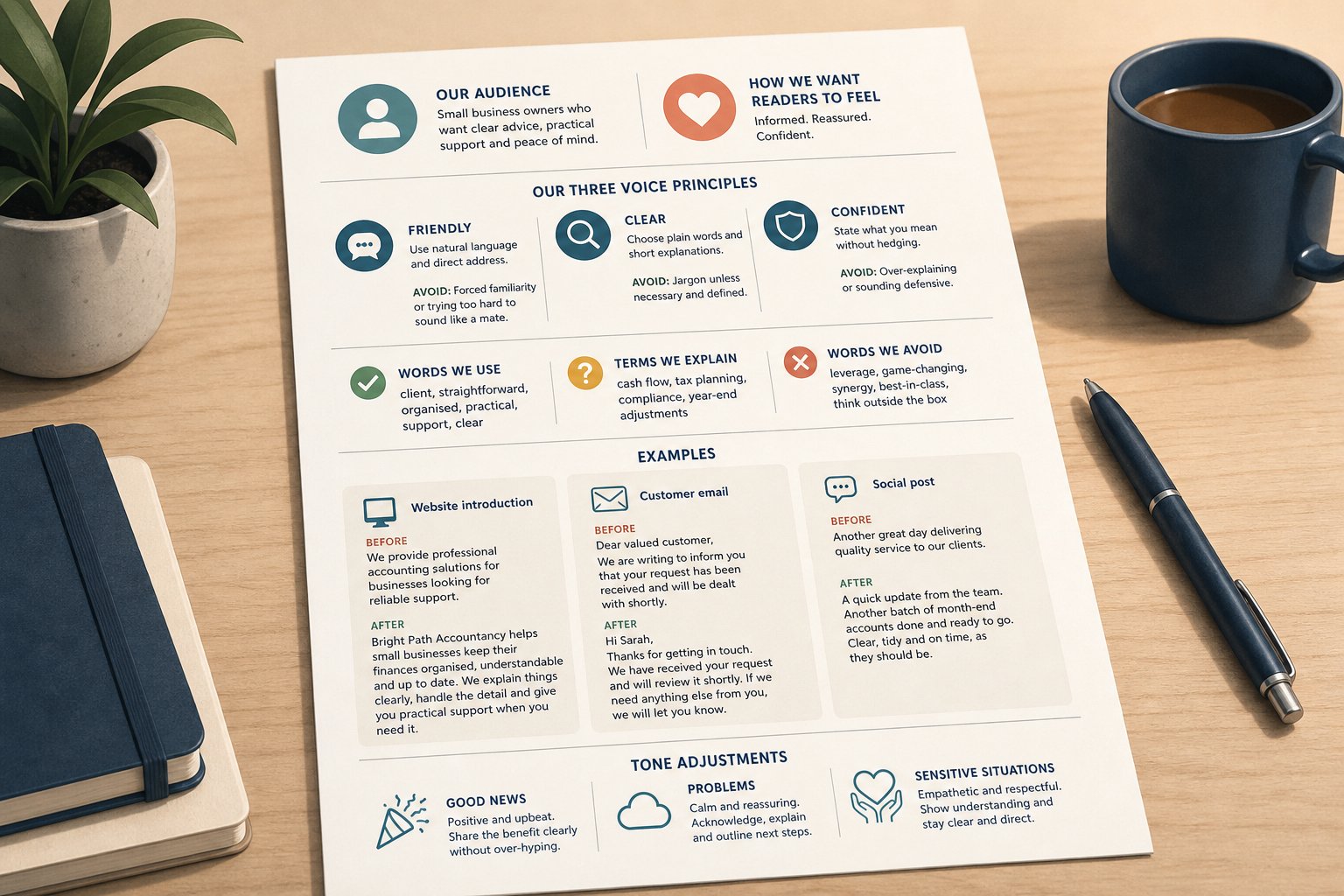
Most teams do not need more brand language. They need better decisions.
That is where brand voice usually gets vague. A team agrees the business should sound “professional, friendly and authentic”, then each writer fills in those words differently. One person goes formal, another leans casual, and a third strips out personality to stay “safe”. The result is inconsistency, even when everyone is trying to help.
A useful brand voice guide does not need to be long. It needs to be specific enough that a colleague, freelancer or AI writing tool can make the same choices your team would make. For many businesses, one page is enough to start: audience, voice principles, vocabulary, examples and a few tone rules.
Start with the audience and the relationship you want
Before you define tone, define the relationship.
Ask who you are writing for, what they need right now and how you want them to feel while reading. A voice guide becomes easier to use when it reflects a real reader situation, not a slogan.
If you are writing for a first-time customer, the aim may be to help them feel informed and comfortable asking questions. That points towards clear explanations, plain terms and a reassuring pace. If you are writing for an experienced buyer, the same business may need a more direct voice that gets to the point quickly.
That distinction matters because brand voice is not just about sounding pleasant. It is about shaping the reader experience. A guide that starts with the audience usually produces more useful content than one that starts with adjectives alone.
Turn broad adjectives into working principles
Instead of listing ten qualities, choose three voice principles you can actually apply.
Each one should do two jobs. It should describe what to do and set a boundary around what to avoid.
For example:
- Friendly: use natural language and direct address. Avoid forced familiarity or trying too hard to sound like a mate.
- Clear: choose plain words and short explanations. Avoid jargon unless it is necessary and defined.
- Confident: state what you mean without hedging. Avoid over-explaining or sounding defensive.
The point is to make the principle operational. “Friendly” on its own is too vague. “Use direct address and plain language, but do not overdo the warmth” gives a writer something to follow.
Choose principles that match how your business actually works. A regulated service, a specialist consultancy and a consumer brand may all sound different, but each should still sound like itself.
Make vocabulary decisions visible
A brand voice guide becomes much more usable when it includes words, not just qualities.
Keep the vocabulary section short and relevant to everyday writing. Include:
- preferred terms for your products or services
- jargon you will explain rather than assume
- terms you avoid because they sound unnatural, vague or off-brand
- phrases that do not fit the way your business speaks
For example, if you use “customer support” internally, do not switch to “care team” in some places and “help desk” in others unless there is a reason. If a term is specialist, decide whether to define it once or replace it with a simpler phrase. If a phrase sounds generic in your sector, name a better alternative.
This is also where AI writing tools benefit from clearer direction. If your guide says “use clients rather than users” or “avoid game-changing and synergy”, the tool has less room to drift towards bland business speak.
Show the voice with before-and-after examples
Examples do more than explain the voice. They show how it works under pressure.
Use a clearly labelled hypothetical business and rewrite a few common pieces of content using the same principles: a website introduction, a customer email and a social post.
Hypothetical business: Bright Path Accountancy
Website introduction, before: We provide professional accounting solutions for businesses looking for reliable support.
Website introduction, after: Bright Path Accountancy helps small businesses keep their finances organised, understandable and up to date. We explain things clearly, handle the detail and give you practical support when you need it.
The second version is more specific about the relationship. It reassures the reader, names the benefit in plain language and avoids empty generalities.
Customer email, before:
Dear valued customer,
We are writing to inform you that your request has been received and will be dealt with shortly.
Customer email, after:
Hi Sarah,
Thanks for getting in touch. We have received your request and will review it shortly. If we need anything else from you, we will let you know.
The revised version keeps the same facts but sounds more human and less formal.
Social post, before: Another great day delivering quality service to our clients.
Social post, after: A quick update from the team. Another batch of month-end accounts done and ready to go. Clear, tidy and on time, as they should be.
Here, the voice is still professional, but it sounds like the business rather than a slogan generator.
Separate consistent voice from situational tone
Voice stays steady. Tone changes with the situation.
A business can sound enthusiastic in a launch announcement and calm in a complaint response without losing consistency. The difference is the emotional register, not the underlying character.
For example:
- Launch announcement: We are pleased to share a new booking feature that makes it easier to schedule time with our team.
- Complaint response: We are sorry this caused frustration. We are looking into it and will update you as soon as we have more information.
Both examples are clear, respectful and direct. The tone changes because the context changes. That distinction helps teams avoid a common mistake: trying to make every message sound upbeat, even when the reader needs reassurance or resolution.
Put the whole guide on one page and test it against real writing
A one-page guide is easiest to use when it follows the same order every time. You can copy this template and fill it in with your own decisions:
- Our audience: Who we are speaking to and what they need.
- How we want readers to feel: Two or three intended impressions.
- Our three voice principles: Each with a specific writing instruction and a boundary.
- Words and phrases we use: A short list of preferred language.
- Words and phrases we avoid: With alternatives where helpful.
- Examples: Two or three short passages that demonstrate our voice.
- Tone adjustments: How we adapt for good news, problems and sensitive situations.
Once you have drafted it, test it against a few real messages. Try a homepage paragraph, a service email and a social post. Look for anything ambiguous. If a rule is open to interpretation, rewrite it so someone else can use it without asking follow-up questions.
That review step matters. A brand voice guide should reduce guesswork, not create it.
Use brand decisions in Hally Writer
This is where Hally Writer fits naturally.
When you turn your brand decisions into a clear profile, audience, voice principles, vocabulary and examples, you give the tool better context to work with. That improves the usefulness of the draft, the structure of the output and the relevance of the review. It does not remove editorial judgement, and it should not. People still need to check whether a piece is accurate, appropriate and genuinely on brand.
What it does do is make your knowledge usable in everyday writing. That is the difference between a vague brand idea and a practical content system.
A one-page guide is enough to start
You do not need a giant style manual to make your content more consistent. You need a small set of decisions that are clear enough to repeat.
If your guide helps someone decide what to say, what to avoid and how to adapt for different situations, it is already doing useful work. Start there, test it on real content and refine the parts that still feel fuzzy.
Put your one-page guide to work. Build your brand profile in Hally Writer and use it to guide your next draft.
Was this article helpful?